Posts

Showing posts with the label Flexible

Bendy batteries a step closer
Image
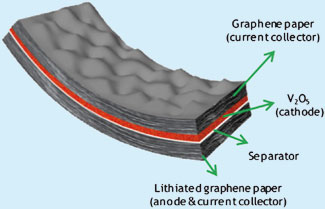
Bendy batteries a step closer 25 February 2011 Scientists from Korea have found that with the use of graphene nanosheets, the fabrication of bendable power sources is possible.  Electronic devices are no longer confined to the home or office. We travel with them, carry them around and even wear them. To make equipment like roll-up displays and wearable devices achievable, the power source that supplies them must also become more flexible.  The major challenge of developing a truly bendable power source has been the shortage of material that is both highly flexible and has superior electronic conductivity. Polymers are typically used, but they can degrade at relatively low temperatures, which makes them less than ideal.  Kisuk Kang from the Korea Advanced Institute of Science and Technology in Daejon, and colleagues, have developed a graphene based hybrid electrode producing a flexible lithium rechargeable battery. The cathode material, in this case V2O5, is grown on graphene paper usi...
A solar battery that automatically recharges gadgets

Image
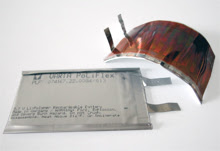
A story in MIT's Technology Review, written by yours truly, looks at progress in the development of solar batteries for small electronic devices. Researchers in Europe have paired together a thin-film organic (polymer) solar cell and a flexible polymer battery, with the end result being a super thin, flexible solar battery that can automatically recharge remote controls, sensors, and even mobile phones when exposed to indoor or natural light. Full story

Flexible battery power

Image
15 March 2007 Japanese scientists have made a paper-like, polymer-based rechargeable battery. The battery, designed by Hiroyuki Nishide, Hiroaki Konishi and Takeo Suga at Waseda University, has an electrode made from a redox-active organic polymer film about 200 nanometres thick. The polymer has nitroxide radical groups which act as charge carriers. The battery has a high charge/discharge capacity because of its high radical density (two radicals for each repeat unit). According to Nishide, this is just one of many advantages the 'organic radical' battery has over other organic-based materials which are limited by the amount of doping. 'The power rate performance is strikingly high - it only takes one minute to fully charge the battery,' said Nishide, 'and it has a long cycle life, often exceeding 1000 cycles.' Full story