Posts

Showing posts with the label Batteries

Ceramic-filled Separators from Porous Power

Image
Unlike dense ceramic coatings applied as a separate layer on competing separators, PPT’s products contain ceramic particles that are thoroughly distributed throughout their chemically inert PVDF polymer. The particles reside primarily in the pore walls, leaving a large and uniform open pore structure that enables ions to pass through with less resistance and less heat generation.  * More power in high-current applications  * Reduced separator shrinkage  * Increased thermal stability with less cell degradation  * Extended cycle life * Higher bake-out and operating temperatures  * Improved puncture and abuse resistance    Although, the application of such separator may improve safety, however according to presented test data it will have minimal effect, or not significant. Depends on battery package, it may have serious explosion (due to electrolyte flammability) at much lower temperature.  

Power bank battery dismantled and reviewed

Image
Power bank battery dismantled and reviewed (backup battery for iPho ne produced in China) Before we start some explanation and disclaimer . Here is a short review, based on observations and simple calculation of one of "power bank" or backup battery for iPhone , which may be found in any shop. I did not intend to do this review simply because I did not buy that device and not going to buy such things in a future (ne ar future ). This example device I have got from my frie nd after its stoped working and actu ally the pla s tic shel l become opened (Fig. 2) . This is not a denunciation or exposure for certain product or certain manufacturer or certain country. I hope t his review will make you more skeptical and realistic about what you see and what you get. All dismantle and photos, as well calculation and conclusions done by me.   Although I dismantle Li -ion batteries (LIB) of any shape and size many times for many years since I have work with it for the l...

The highly heat-resistant separator coated with Teijinconex meta-aramid

Image
Hydrocarbon polymer electrolyte membrane (Photo credit: SandiaLabs ) The highly heat-resistant separator coated with Teijinconex meta-aramid The new separator, which is coated with a fluorine-based compound, is designed for use in laminated-type LIBs. Such LIBs, which feature a gel polymer electrolyte, are used in tablets and smartphones. The new separator readily adheres to the polymer electrolyte and is highly resistant to oxidation, resulting in LIBs that offer greater safety, higher output and longer lifespans. The highly heat-resistant separator coated with Teijinconex meta-aramid maintains its shape even at 250℃. In spot heating tests, Teijin has verified that the separator does not break down even at 350℃. Also, thanks to the separator's superior resistance to oxidation, it enables unprecedented capacity and energy density for liquid-electrolyte cylindrical LIBs used in products including PCs and vehicles. These LIBs also achieve higher levels of safety and longer life...
Image
GBL-based electrolyte for Li-ion battery: thermal and electrochemical performance   Journal of Solid State Electrochemistry: Volume 16, Issue 2 (2012), Page 603-615 Thermal stability, flammability, and electrochemical performances of the cyclic carbonate-based electrolytes [where γ-butyrolactone (GBL) is a main component (at least 50 vol.%) among of EC and PC with LiBF 4 ] have been examined in comparison with contemporary (EC/EMC, 1:3 vol.%, 1 M LiPF 6 ) electrolyte by DSC, accelerating rate calorimetry (ARC), AC impedance, and cyclic voltammetry (CV). This study shows that GBL-based electrolytes have perfect thermal stability and will improve Li-ion battery safety (including flammability) without performance trade-off with the accurate combination of active materials and separator. Several types of negative electrode materials (such as hard carbon, MCMB, and SWF) have been tested to evaluate GBL-based electrolyte influence on SEI formation and battery performanc...

Patent watch: SEPARATOR INCLUDING POROUS COATING LAYER AND ELECTROCHEMICAL DEVICE

Disclosed is a separator. The separator includes a planar non-woven fabric substrate having a plurality of pores, and a porous coating layer formed on at least one surface of the non-woven fabric substrate. The porous coating layer is composed of a mixture of filler particles and a binder polymer. The filler particles include conductive positive temperature coefficient (PTC) particles composed of a mixture of conductive particles and a low melting point resin having a melting point lower than that of the non-woven fabric substrate. Due to the presence of the conductive PTC particles, the porous coating layer can be imparted with a shutdown function against thermal runaway. In addition, the porous coating layer exhibits appropriate electrical conductivity. Therefore, the separator is suitable for use in a high-capacity electrochemical device. Inventors: Pil-Kyu Park, Jong-Hun Kim, Soon-Ho Ahn, Je-Young Kim Original Assignee: LG CHEM, LTD. Application number: 13/173,902; Publication...

Optimising organic ionic plastic crystal electrolyte for all solid-state and higher than ambient temperature lithium batteries

from Journal of Solid State Electrochemistry Abstract   Organic ionic plastic crystal (OIPC) electrolytes are among the key enabling materials for solid-state and higher than ambient temperature lithium batteries. This work overviews some of the parameter studies on the Li|OIPC interface using lithium symmetrical cells as well as the optimisation and performance of Li|OIPC|LiFePO 4 cells. The effects of temperature and electrolyte thickness on the cycle performance of the lithium symmetrical cell, particularly with respect to the interfacial and bulk resistances, are demonstrated. Whilst temperature change substantially alters both the interfacial and bulk resistance, changing the electrolyte thickness predominantly changes the bulk resistance only. In addition, an upper limit of the current density is demonstrated, above which irreversible processes related to electrolyte decomposition take place. Here, we demonstrate an excellent discharge capacity attained on LiFePO 4 |...

Patent watch: ELECTROLYTE COMPOSITIONS FOR BATTERIES USING SULPHUR OR SULPHUR COMPOUNDS

Image
There are disclosed electrolytes comprising solutions of lithium salts with large anions in polar aprotic solvents with a particular concentration of background salts. The concentration of the background salts is selected to be equal or close to the concentration of a saturated solution of these salts in the aprotic solvents used. The electrolytes disclosed can be used in chemical sources of electric energy such as secondary (rechargeable) cells and batteries comprising sulphur-based positive active materials. The use of such electrolytes increases cycling efficiency and cycle life of the cells and batteries. Inventors: Vladimir KOLOSNITSYN, Elena KARASEVA  Application number: 13/153,157 Publication number: US 2011/0236766 A1 Filing date: Jun 3, 2011 Fig. 1 Charge/discharge capacity fade of standard Li-S cell Fig. 9 Charge/discharge capacity fade of Li-S cell with a saturated electrolyte solution as 1.7M of LiClO4 in methylpropylsulfone @ 0.25C ch/dch Fast...

New high-power Si–graphene composite electrode for Li-ion batteries

Image
New high-power Si–graphene composite electrode for Li-ion batteries : Northwestern Univ. researchers report on a new high-power Si–graphene composite anode material for Li-ion batteries in the journal Advanced Energy Materials . With current technology, the capabilities of a lithium-ion battery are limited in two ways: energy capacity is limited by the charge density, and charge rate is limited by the speed at which the lithium ions can make their way from the electrolyte into the anode. The Northwestern research team combined two techniques to combat both these problems. First, to stabilize the silicon in order to maintain maximize charge capacity, they sandwiched clusters of silicon between the graphene sheets. This allowed for a greater number of lithium ions in the electrode while utilizing the flexibility of graphene sheets to accommodate the volume changes of silicon during use. Rendering of the composite electrode with sandwiched Si clusters and in-plane defects. Clic...

Patent watch: NON-AQUEOUS ELECTROLYTE SOLUTION FOR LITHIUM SECONDARY BATTERY AND LITHIUM

Image
Disclosed are a non-aqueous electrolyte solution for a lithium secondary battery and a lithium secondary battery comprising the same. The non-aqueous electrolyte solution for a lithium secondary battery may include difluorotoluene having a lowest oxidation potential among components of the non-aqueous electrolyte solution. The lithium secondary battery may have improvement in basic performance including high rate charge/discharge characteristics, cycle life characteristics, and the like, and may remarkably reduce swelling caused by decomposition of an electrolyte solution under high voltage conditions such as overcharge. Inventors: Jong-Ho Jeon, Yong-Gon Lee, Seung-Woo Chu, Shul-Kee Kim, Hyun-Yeong Lee, Jae-Deok Jeon Application number: 13/164,107 Publication number: US 2011/0244339 A1 Filing date: Jun 20, 2011 Related articles Fluoride shuttle increases storage capacity: Researchers develop new concept for rechargeable batteries (sciencedaily.com) Fluoride shuttle ...

Patent watch: ELECTROCHEMICAL DEVICE WITH ALTERNATIVE SEPARATOR SYSTEM

Image
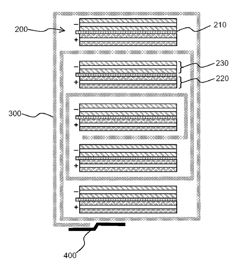
New patent application from LG Chem : Provided is an electrochemical device comprising multi-stacked unit cells of full cells or bicells and a separation film disposed therebetween, whereby the separation film and separators are alternately stacked between electrode layers with an opposite polarity. Herein, as the separation film is formed of a material having a higher thermal shrinkage rate than that of the separator, the thermal stability of the device can be secured by stable induction of shutdown via thermal behavior of the separation film, without causing short-circuiting due to thermal shrinkage of the separator even when a temperature of a battery suddenly rises by internal or external factors. Application number: 13/107,122  Publication number: US 2011/0217586 A1 Filing date: May 13, 2011  Inventors: Je Young KIM, Pil Kyu PARK, Soonho AHN Original Assignee: LG CHEM, LTD.   O riginal separator placement New separator placement Also some Claims sug...

AIST team developing Li-air capacitor-battery targeted for EVs

Image
AIST team developing Li-air capacitor-battery targeted for EVs : A team from Japan’s AIST ( National Institute of Advanced Industrial Science and Technology ) reports on the development of a “lithium–air capacitor–battery based on a hybrid electrolyte ” in a paper in the RSC journal Energy & Environmental Science . The team had earlier investigated a hybrid electrolyte lithium–air battery, in which a lithium anode in a non-aqueous electrolyte and an air-catalytic cathode in an aqueous electrolyte solution were separated by a ceramic LISICON film. ( Earlier post .) As reported then, the lithium-air cell showed a continuous cathode discharge capacity of 50,000 mAh g -1 (per unit mass of the carbon, catalyst and binder). By comparison, conventional Li-ion batteries offer 120-150 mAh g -1 (active material + conduction assisting carbon + binder), and conventional lithium-air cells offer 700-3,000 mAh g -1 . In the present work, a capacitor electrode was put in the non-aque...

Fast Lithium-Ion Conducting Thin-Film Electrolytes Integrated Directly on Flexible Substrates for High-Power Solid-State Batteries

Image
Fast Lithium-Ion Conducting Thin-Film Electrolytes Integrated Directly on Flexible Substrates for High-Power Solid-State Batteries : By utilizing an equilibrium processing strategy that enables co-firing of oxides and base metals, a means to integrate the lithium -stable fast lithium-ion conductor lanthanum lithium tantalate directly with a thin copper foil current collector appropriate for a solid-state battery is presented. This resulting thin-film electrolyte possesses a room temperature lithium- ion conductivity of 1.5 × 10 −5 S cm −1 , which has the potential to increase the power of a solid-state battery over current state of the art. (Via Advanced Materials ) Related articles Fluoride shuttle increases storage capacity (eurekalert.org)

Well-dispersed bi-component-active CoO/CoFe2O4 nanocomposites with tunable performances as anode materials for lithium-ion batteries

Image
Well-dispersed bi-component-active CoO/CoFe2O4 nanocomposites with tunable performances as anode materials for lithium-ion batteries : Chem. Commun. , 2012, Advance Article DOI : 10.1039/C1CC15322F, Communication Meixia Li, Ya-Xia Yin, Congju Li, Fazhi Zhang, Li-Jun Wan, Sailong Xu, David G. Evans CoO/CoFe 2 O 4 nanocomposites, calcined from hydrotalcite precursors, exhibit tunable cycle performances and rate capabilities underlain by well-dispersed bi-component active phases. To cite this article before page numbers are assigned, use the DOI form of citation above. The content of this RSS Feed (c) The Royal Society of Chemistry (Via RSC - Chem. Commun. latest articles ) Related articles Graphene nanocomposite a bridge to better batteries (sciencedaily.com) Scientists Discover Promising Experimental Nanocomposite Fire Retardant (azonano.com) Graphene-based nanocomposite to boost battery performance (news.bioscholar.com) NaturalNano Receives Allowance for Crucia...