Posts

Showing posts with the label battery

More on Tesla Catches Fire (2013)

Article on Business Insider : Tesla Stock Is Tanking After A Third Model S In Two Months Catches Fire ( Mamta Badkar Nov. 7, 2013) A Tesla Model S car caught fire on Wednesday in Smyrna, Tennessee, according to Tesla Motors Club blog (via ValueWalk). This is the third Tesla to Model S vehicle to catch fire in the past six weeks, a Tesla spokesperson confirmed to Reuters. The driver of the vehicle was said to have sustained no injuries and a Tesla team is on its way to Tennessee to see what happened. Tesla again pointed out that the fire was the result of an accident and not  "spontaneous." @Nashvillian_ on Twitter posted this image : I-24 #tesla #teslafire pic.twitter.com/ia9tbftn4V — E (@NASHVILLAIN_) November 6, 2013 A Tesla Model S caught fire in Mexico back in October after the car crashed through a concrete wall and into a tree. Before that, another Model S caught fire after colliding with a large me...

Polypore’s Celgard Files Suit Against Sumitomo Over Batteries - Bloomberg

Polypore’s Celgard Files Suit Against Sumitomo Over Batteries - Bloomberg : "" The complaint, filed Feb. 22 in federal court in Charlotte, North Carolina, claims Sumitomo is infringing a patent issued in 2002 for a separator in high-energy rechargeable batteries. The separators prevent short circuits that can reduce efficiency and limit safety problems from overheating. (Via Bloomberg .)

Teijin CNF Korea begins production of LIELSORT separators for Li-ion batteries

Image
Teijin CNF Korea begins production of LIELSORT separators for Li-ion batteries : Teijin CNF Korea Co., Ltd., an Asan-based joint venture between Teijin and major Korean film processor CNF, has begun commercial production of LIELSORT, a Teijin-developed separator for lithium ion secondary batteries (LIBs). Of the two types of LIELSORT-branded separators, Teijin CNF Korea will initially produce one type coated with a fluorine-based compound that achieves superior adhesion to the polymer electrolyte and is highly resistant to oxidation, resulting in LIBs that offer higher output while maintaining stable high voltage. The company also plans to soon begin producing the second type, a highly heat-resistant separator coated with Teijinconex meta-aramid. As part of market expansion strategies for LIELSORT, Teijin has established a wholly owned subsidiary in Seoul called Teijin Electronics Korea Co., Ltd. to sell both separators. This production and sales network, which has close connecti...

Lithium's Prospects - Seeking Alpha

Lithium's Prospects - Seeking Alpha : As gas prices reach a staggering $4 per gallon, with early predictions in the $5 range for summer, many consumers who have been reluctant might now be considering the electric alternatives to keep their wheels turning. Lithium-ion batteries, the technology in hybrid electric cars and consumer electronics, are just one part of the lithium market but could be where the most growth and potential lie. Lithium is used in a wide range of applications, from nuclear weapons to medicine. As of 2010, the most common use for lithium was as flux for glass and ceramics (29% of lithium usage in the USA), with the battery industry trailing closely (27%). The most notable use of lithium-ion batteries is in purely electric and hybrid electric vehicles, but lithium also powers cell-phones, iPods, iPads, laptop computers, and other consumer electronics. Some of its other uses can be seen in high-heat lubricating greases, air purification, certain optical devices...

Panasonic to begin mass-production of long-life Li-ion battery system for solar-powered homes in Europe

Image
Panasonic to begin mass-production of long-life Li-ion battery system for solar-powered homes in Europe : Panasonic Corporation will begin mass- production this month of a compact, secure and long-life lithium-ion battery system the company has developed for European homes. This marks the first time for the company to produce in volume such a system designed for Europe. The lithium-ion battery system consists of the Panasonic battery module with nominal capacity of 1.35 kWh and a battery management system designed to control charge and discharge of the battery in accordance with customer needs. The battery system stores excess energy generated from the photovoltaic (PV) power system during peak hours of PV generation and discharges the energy as needed, providing a solution as a household battery storage system that helps self-consumption of solar-generated power. It will also enable households to reduce the dependence on grid power and facilitate the further spread of green ener...

new iPad`s (3?) battery capacity upgrade

According to DigiTimes Apple may increase battery capacity of upcoming high-end version of new iPad The battery capacity for the high-end version of Apple's new iPad - due to be unveiled in January 2012 - will be increased to 14,000mAH compared to 6,500mAH used currently, according to industry sources. Apple's battery suppliers Simplo Technology and Dynapack declined to comment on matters concerning clients. {Apple is set to unveil two versions of its next-generation tablet, one for the high-end segment and one for the mid-range segment, the sources said.}? Meanwhile, the penetration rate of lithium-polymer batteries such as those used in iPad 2 is expected to reach 15% in 2012 compared to 5% in 2011, the sources estimated. Global production of lithium-polymer battery cells will top 400 million units in 2011, and the prices of the cells are expected to remain higher in 2012 after being hiked by 20% in the second quarter of 2011, the sources indicat...

Batteries get a quick charge with new anode technology from Argonne

Image
Image via Wikipedia Image via Wikipedia A breakthrough in components for next-generation batteries could come from special materials that transform their structure to perform better over time. A team of researchers at the U.S. Department of Energy 's Argonne National Laboratory , led by Argonne nanoscientist Tijana Rajh and battery expert Christopher Johnson, discovered that nanotubes composed of titanium dioxide can switch their phase as a battery is cycled, gradually boosting their operational capacity. Laboratory tests showed that new batteries produced with this material could be recharged up to half of their original capacity in less than 30 seconds. By switching out conventional graphite anodes for ones composed of the titanium nanotubes, Rajh and her colleagues witnessed a surprising phenomenon. As the battery cycled through several charges and discharges, its internal structure began to orient itself in a way that dramatically improved the battery's performance. …...

Batteries for the future - environmental inpact

One of the most important decisions facing designers of plug-in electric or hybrid vehicles is related to battery choice. Now, researchers at the Norwegian University of Science and Technology (NTNU) have used a life cycle analysis to examine three vehicle battery types to determine which does the best job of powering the vehicle while causing the least amount of environmental impact during its production .... The researchers were surprised to find that except for ozone depletion potential, the NiMH battery performed significantly worse than the two Li-ion batteries for all impact categories. The researchers attributed this difference to the greater use phase efficiency of Li-ion relative to NiMH, and the fact that each kilogram of Li-ion battery is expected to store between 2 to 3 times more energy than the other battery types over the course of its lifetime. ... Batteries for the future

Bendy batteries a step closer

Image
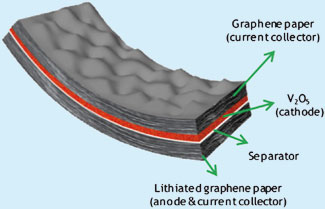
Bendy batteries a step closer 25 February 2011 Scientists from Korea have found that with the use of graphene nanosheets, the fabrication of bendable power sources is possible.  Electronic devices are no longer confined to the home or office. We travel with them, carry them around and even wear them. To make equipment like roll-up displays and wearable devices achievable, the power source that supplies them must also become more flexible.  The major challenge of developing a truly bendable power source has been the shortage of material that is both highly flexible and has superior electronic conductivity. Polymers are typically used, but they can degrade at relatively low temperatures, which makes them less than ideal.  Kisuk Kang from the Korea Advanced Institute of Science and Technology in Daejon, and colleagues, have developed a graphene based hybrid electrode producing a flexible lithium rechargeable battery. The cathode material, in this case V2O5, is grown on graphene paper usi...

newcomer Ioxus with hybrid batteries which tease big energy capacity while charging in seconds

Image
Ioxus Inc. is an up and comer in the energy storage industry that has plans this Monday to announce a new hybrid storage device that it hopes will radically alter batteries used in the auto, medical, and consumer electronics industries. The teased product is said to be roughly the size of a typical C-cell battery and combines the fast charge / discharge benefits of ultracapacitors with the impressive energy-to-weight ratio of a lithium-ion electrode. As a result, Ioxus says the hybrid devices can store more than double the energy of traditional ultracapacitors and charge in a matter of seconds. The catch is that the hybrids have shorter life spans of 20,000 cycles compared to millions of cycles for typical ultracapacitors. We're also taking this with a grain of skepticism until these claims are proven in the field. Some brief digging though did unearth an article written by MIT researchers and published in Scientific American last year that discusses the possible benefits of s...

Ineffectiveness of electrolyte additives-ECS211, Chicago, 2007

Image
Link to presentation

Graphene & lithium-ion battery

Image
Article in Journal of Materials Chemistry titled as Flexible and planar graphene conductive additives for lithium-ion batteries and describes yet another graphene application in Li ion batteries. Authors claimed that Graphene is introduced into a lithium-ion battery (LIB) as a type of novel but powerful planar conductive additive and the flexible graphene-based conducting network is characterized by a novel “plane-to-point” conducting mode with exceptional electron transport properties and unique geometrical nature (a soft and ultrathin planar structure). With a much lower fraction of graphene additives than those of commercial carbon based additives, the graphene-introduced LiFePO4 cathode shows better charge/discharge performance than commercial cases. Graphene also shows a better performance compared to carbon nanotubes, another type of novel conductive additive with similar fractions. These results present us an indication that graphene will possibly find early application...

New High-Capacity Anode Material for Lithium Ion Batteries from Stanford University

Image
New hybrid materials of Mn3O4 nanoparticles on reduced graphene oxide (RGO) sheets for lithium ion battery applications have been developed in Department of Chemistry and Laboratory for Advanced Materials and Department of Materials Science and Engineering, Stanford University. They selectively grow of Mn3O4 nanoparticles on RGO sheets, and in contrast to free particle growth in solution it allowed for the electrically insulating Mn3O4 nanoparticles to be wired up to a current collector through the underlying conducting graphene network. The Mn3O4 nanoparticles formed on RGO show a high specific capacity up to 900 mAh/g, near their theoretical capacity, with good rate capability and cycling stability, owing to the intimate interactions between the graphene substrates and the Mn3O4 nanoparticles grown atop. The Mn3O4/RGO hybrid could be a promising candidate material for a high-capacity, low-cost, and environmentally friendly anode for lithium ion batteries. Such approach may offer a ...

Lithium Polymer Battery Explosion's (liposack) Video

Here are some new testings (overcharge) of Li-ion polymer batteries enjoy video taken from http://www.lithumbattery.com/

A Critical Size of Silicon Nano-Anodes for Lithium Rechargeable Batteries

Image
Angewandte Chemie International Edition Volume 49 Issue 12, Pages 2146 - 2149 Hyejung Kim, Minho Seo, Mi-Hee Park, Jaephil Cho, Prof. * School of Energy Engineering and Converging Research Center for Innovative Battery Technologies, Ulsan National Institute of Science & Technology, Ulsan, 689-798 (Korea) http://jpcho.com KEYWORDS batteries • carbon • electrochemistry • lithium • silicon ABSTRACT Well-dispersed Si nanocrystals with sizes of approximately 5, 10, and 20 nm were prepared in reverse micelles at high pressure and 380 °C and investigated as anode materials for lithium batteries. The 10 nm sized nanocrystals show a first charge capacity y of 3380 mAh g-1 and the highest capacity retention of 81 % after 40 cycles, which can be increased to 96 % by carbon coating (see picture). Received: 8 November 2009; Revised: 27 December 2009 (DOI) 10.1002/anie.200906287 source: http://www3.interscience.wiley.com/journal/123295109/abstract

New international safety rules agreed for electric cars

Image
New international safety rules agreed for electric cars : "An international safety standard for electric and hybrid vehicles has been adopted this week as the ‘World Forum for Harmonization of Vehicle Regulations’. The adoption of the new type approval clears the way for the early uptake of electric cars across 41 countries which have mutual recognition of this approval. The new regulations cover all [...] " (Via Green cars: latest news .)

Small collection of Li-ion battery explosion (from different sources) - I

1. - Just a joke 2. Really bad - laptop battery explosion 3. Home experiment - soft pack Li-ion battery overcharge 4. Old laptop no the heater plate - frying -> explosion (what you expect?)

French pilot successfully flies battery-powered aircraft for 48 minutes

London, January 3 (ANI): It seems that the dream of environmentally friendly aviation is very close to reality, with a French test pilot successfully flying an aircraft propelled by an electric motor. The Electra is a single-seater plane, made up of wood and fabric. Having flown for 48 minutes for 50km around the southern Alps, it has proved that applying battery power to a fixed-wing standard aircraft is possible. The APAME group, founded to develop green aviation, announced this groundbreaking flight. This will be a real aeroplane that will have an airworthiness certificate. It is a machine built for anyone with a pilots licence, Times Online quoted Anne Lavrand, president of APAME, as saying. She also revealed that her team, financed by French aerospace companies and other donors, started working on this project quietly 18 months ago. When we began, no one believed we could do it, she said. Lavrand further revealed that her group used a Souricette kit aircraft, and adapted to it a 2...

The story never end?

Image
It was September 20, 1995 when Apple recalled their new PowerBook 5300 for the first time. The PowerBook 5300 was a big product for Apple. The company had entered into a cross-promotional deal with the producers of Mission Impossible wherein the computer appeared (with a command line interface) throughout the blockbuster movie. Apple was also charging a phenomenal price for the machine, a whopping $6,500 for the 5300ce partly because it was Apple’s first PowerPC-based laptop. The good times didn’t last long. Less than a month after it was introduced, the machine was recalled when preproduction units caught on fire. The problem was blamed on batteries manufactured by Sony, but Apple recalled all the computers sold to that point (claiming that was less than 100 units). The 5300 went on to be recalled again for case problems, but the first recall (and the impetus for a lot of jokes) came this week in 1995 less than a month after the PowerBook 5300 had been released. Source

Battery-like device could power electric cars - CNN.com, Fri September 7, 2007

Yet another "hybrid" type or some kind of battery/capacitor energy storage concept... Battery-like device could power electric cars - CNN.com : "AUSTIN, Texas (AP) -- Millions of inventions pass quietly through the U.S. patent office each year. Patent No. 7,033,406 did, too, until energy insiders spotted six words in the filing that sounded like a death knell for the internal combustion engine. An Austin-based startup called EEStor promised 'technologies for replacement of electrochemical batteries,' meaning a motorist could plug in a car for five minutes and drive 500 miles roundtrip between Dallas and Houston without gasoline. By contrast, some plug-in hybrids on the horizon would require motorists to charge their cars in a wall outlet overnight and promise only 50 miles of gasoline-free commute. And the popular hybrids on the road today still depend heavily on fossil fuels. 'It's a paradigm shift,' said Ian Clifford, chief executive of Toronto-base...