Posts

Showing posts with the label Nano

Surfactant-free nonaqueous synthesis of lithium titanium oxide (LTO) nanostructures for lithium ion battery applications

Image
RSC - J. Mater. Chem. latest articles Nicola Pinna Seung-Ho Yu, Andrea Pucci, Tobias Herntrich, Marc-Georg Willinger, Seung-Hwan Baek, Yung-Eun Sung, Nicola Pinna A one-pot template-free solvothermal synthesis of crystalline Li 4 Ti 5 O 12   nanostructures based on the “benzyl alcohol route” is introduced. The 1–2 µm sized nanostructured spherical particles are constituted of nanocrystallites in the size range of a few nm. This is the first report showing that crystalline Li 4 Ti 5 O 12   can be directly obtained by soft chemistry solution routes. The as-synthesized crystalline nanostructures show good lithium intercalation/deintercalation performances at high rates (up to 30 C) and good cycling stabilities. Annealing the nanostructures at 750 °C improves the performance, which approaches the theoretical capacity of Li 4 Ti 5 O 12   with no noticeable (less than 5%) capacity loss after 200 cycles. (Paper from J. Mater. Chem.) Seung-Ho Yu, J. Mater. Chem., 2011, ...

New high-power Si–graphene composite electrode for Li-ion batteries

Image
New high-power Si–graphene composite electrode for Li-ion batteries : Northwestern Univ. researchers report on a new high-power Si–graphene composite anode material for Li-ion batteries in the journal Advanced Energy Materials . With current technology, the capabilities of a lithium-ion battery are limited in two ways: energy capacity is limited by the charge density, and charge rate is limited by the speed at which the lithium ions can make their way from the electrolyte into the anode. The Northwestern research team combined two techniques to combat both these problems. First, to stabilize the silicon in order to maintain maximize charge capacity, they sandwiched clusters of silicon between the graphene sheets. This allowed for a greater number of lithium ions in the electrode while utilizing the flexibility of graphene sheets to accommodate the volume changes of silicon during use. Rendering of the composite electrode with sandwiched Si clusters and in-plane defects. Clic...

Batteries get a quick charge with new anode technology from Argonne

Image
Image via Wikipedia Image via Wikipedia A breakthrough in components for next-generation batteries could come from special materials that transform their structure to perform better over time. A team of researchers at the U.S. Department of Energy 's Argonne National Laboratory , led by Argonne nanoscientist Tijana Rajh and battery expert Christopher Johnson, discovered that nanotubes composed of titanium dioxide can switch their phase as a battery is cycled, gradually boosting their operational capacity. Laboratory tests showed that new batteries produced with this material could be recharged up to half of their original capacity in less than 30 seconds. By switching out conventional graphite anodes for ones composed of the titanium nanotubes, Rajh and her colleagues witnessed a surprising phenomenon. As the battery cycled through several charges and discharges, its internal structure began to orient itself in a way that dramatically improved the battery's performance. …...

Bendy batteries a step closer

Image
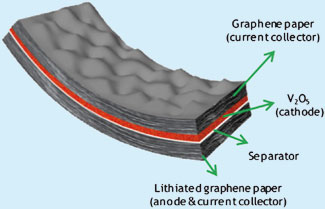
Bendy batteries a step closer 25 February 2011 Scientists from Korea have found that with the use of graphene nanosheets, the fabrication of bendable power sources is possible.  Electronic devices are no longer confined to the home or office. We travel with them, carry them around and even wear them. To make equipment like roll-up displays and wearable devices achievable, the power source that supplies them must also become more flexible.  The major challenge of developing a truly bendable power source has been the shortage of material that is both highly flexible and has superior electronic conductivity. Polymers are typically used, but they can degrade at relatively low temperatures, which makes them less than ideal.  Kisuk Kang from the Korea Advanced Institute of Science and Technology in Daejon, and colleagues, have developed a graphene based hybrid electrode producing a flexible lithium rechargeable battery. The cathode material, in this case V2O5, is grown on graphene paper usi...

A Critical Size of Silicon Nano-Anodes for Lithium Rechargeable Batteries

Image
Angewandte Chemie International Edition Volume 49 Issue 12, Pages 2146 - 2149 Hyejung Kim, Minho Seo, Mi-Hee Park, Jaephil Cho, Prof. * School of Energy Engineering and Converging Research Center for Innovative Battery Technologies, Ulsan National Institute of Science & Technology, Ulsan, 689-798 (Korea) http://jpcho.com KEYWORDS batteries • carbon • electrochemistry • lithium • silicon ABSTRACT Well-dispersed Si nanocrystals with sizes of approximately 5, 10, and 20 nm were prepared in reverse micelles at high pressure and 380 °C and investigated as anode materials for lithium batteries. The 10 nm sized nanocrystals show a first charge capacity y of 3380 mAh g-1 and the highest capacity retention of 81 % after 40 cycles, which can be increased to 96 % by carbon coating (see picture). Received: 8 November 2009; Revised: 27 December 2009 (DOI) 10.1002/anie.200906287 source: http://www3.interscience.wiley.com/journal/123295109/abstract

Electric motorcycle smashes records

The KillaCycle, an all-electric motorcycle, is now the fastest electric vehicle of all time. At a drag race in Chandler, Ariz., the bike completed a quarter mile in 8.168 seconds, breaking the six-year-old record of 8.801 held by Dennis Berube with an electric car for more than six years. The bike cranked it up to 155.87 miles an hour. Even more impressive, it hit this level of performance twice, on April 3 and April 4. The bike is powered by 990 lithium ion cells from A123 Systems, a Massachusetts start-up that is also making batteries for General Motors. (A123 also makes the batteries for the Atlas Powered Rope Ascender, a device invented at MIT that can scoot a person 300 feet up a rope in about a half a minute.) An earlier version of the bike only had 880 battery cells. Full story

Lithium Battery Technologies Commercialization

Image
back to 2006 again when Nanoexa and Decktron jointly announced a definitive agreement to develop and transfer into commercial use new lithium battery technology originally developed at the U.S. Department of Energy’s Argonne National Laboratory. The goal of this agreement is to commercialize next generation rechargeable lithium battery technologies from Argonne’s Battery Technology Department. Together, the organizations will introduce into the marketplace batteries with increased power output, storage capacity, safety and lifetime that will be utilized in high-rate applications such as hybrid/electric vehicles, power tools, and radio control devices. Full story

Nanostructured Materials That May Increase Lifespan of High-Capacity Energy Systems

back to summer of 2006 A research team led by Carnegie Mellon University Materials Science and Biomedical Engineering Professor Prashant Kumta has discovered a nanocrystalline material that is cheaper, more stable and produces a higher quality energy storage capacity for use in a variety of industrial and portable consumer electronic products. Kumta said the discovery, published this summer in Advanced Materials Journal, has important implications for increasing the longevity of rechargeable car batteries, fuel cells and other battery-operated electronic devices. "We have found that synthesis of nanostructured vanadium nitride and controlled oxidation of the surface at the nanoscale is key to creating the next generation of supercapacitors commonly used in everything from cars, camcorders and lawn mowers to industrial backup power systems at hospitals and airports," Kumta said. Full story

Li-ion Battery, Nanostructuring

Researchers at Delft University of Technology can predict how nanostructuring – the extreme reduction of structure – will affect the performance of Li-ion batteries. The nanostructuring of battery materials is likely to be common practice in the future, but it is not always performance-enhancing. The research findings have recently been published in the Journal of the American Chemical Society. A Li-ion battery is currently the smallest and lightest way to store as much rechargeable electrical energy as possible. However, the batteries are slow to charge and discharge, and this restricts their suitability for applications such as hybrid and electric vehicles. This sluggish performance is largely determined by the relatively long distance the lithium-ions have to travel through the electrode material in the battery. The speed at which the ions make their way through the electrode material is also slow compared to that in electrolyte (the fluid between the electrode material). The curren...