Posts

Showing posts with the label graphene

Bendy batteries a step closer
Image
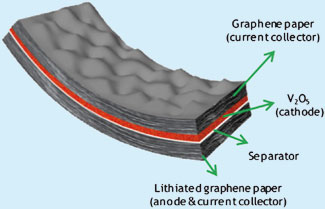
Bendy batteries a step closer 25 February 2011 Scientists from Korea have found that with the use of graphene nanosheets, the fabrication of bendable power sources is possible.  Electronic devices are no longer confined to the home or office. We travel with them, carry them around and even wear them. To make equipment like roll-up displays and wearable devices achievable, the power source that supplies them must also become more flexible.  The major challenge of developing a truly bendable power source has been the shortage of material that is both highly flexible and has superior electronic conductivity. Polymers are typically used, but they can degrade at relatively low temperatures, which makes them less than ideal.  Kisuk Kang from the Korea Advanced Institute of Science and Technology in Daejon, and colleagues, have developed a graphene based hybrid electrode producing a flexible lithium rechargeable battery. The cathode material, in this case V2O5, is grown on graphene paper usi...

Graphene & lithium-ion battery

Image
Article in Journal of Materials Chemistry titled as Flexible and planar graphene conductive additives for lithium-ion batteries and describes yet another graphene application in Li ion batteries. Authors claimed that Graphene is introduced into a lithium-ion battery (LIB) as a type of novel but powerful planar conductive additive and the flexible graphene-based conducting network is characterized by a novel “plane-to-point” conducting mode with exceptional electron transport properties and unique geometrical nature (a soft and ultrathin planar structure). With a much lower fraction of graphene additives than those of commercial carbon based additives, the graphene-introduced LiFePO4 cathode shows better charge/discharge performance than commercial cases. Graphene also shows a better performance compared to carbon nanotubes, another type of novel conductive additive with similar fractions. These results present us an indication that graphene will possibly find early application...

New High-Capacity Anode Material for Lithium Ion Batteries from Stanford University

Image
New hybrid materials of Mn3O4 nanoparticles on reduced graphene oxide (RGO) sheets for lithium ion battery applications have been developed in Department of Chemistry and Laboratory for Advanced Materials and Department of Materials Science and Engineering, Stanford University. They selectively grow of Mn3O4 nanoparticles on RGO sheets, and in contrast to free particle growth in solution it allowed for the electrically insulating Mn3O4 nanoparticles to be wired up to a current collector through the underlying conducting graphene network. The Mn3O4 nanoparticles formed on RGO show a high specific capacity up to 900 mAh/g, near their theoretical capacity, with good rate capability and cycling stability, owing to the intimate interactions between the graphene substrates and the Mn3O4 nanoparticles grown atop. The Mn3O4/RGO hybrid could be a promising candidate material for a high-capacity, low-cost, and environmentally friendly anode for lithium ion batteries. Such approach may offer a ...